;)
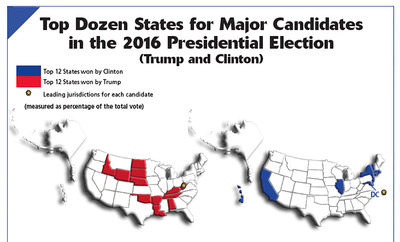 Maps illustrate the geography of elections, whether a single election or a series of elections.Since its inception in 2000, “The Rhodes Cook Letter” has been following U.S. elections for president, Congress, and governorships, as well as providing analysis of voting trends that these elections produce. In both presidential and midterm election cycles, the Letter takes a close look at primary contests as well as the November balloting, with an interest in placing both primary and general election results in historical context.
This is done with the help of various forms of charts and artwork presented in living Technicolor. They are designed to illustrate in a straightforward and colorful fashion, the basic points that are being made in each issue. Maps, line graphs, and bar graphs, in particular, are featured.
From 2000 through 2016, the Letter was published on a bimonthly basis, with a total of six issues per year. Since 2018, the Letter has moved to a four times a year publishing schedule.
Unlike in the past, when the Letter was sold only on an annual subscription basis, there are now two options. The first is to purchase four issues, which would cover a year’s worth. The other option is a new one: to buy the Letter on an issue by issue basis. With either option, payment can be made by cash, check, or now through PayPal.
Thanks for your interest in the Letter. Further information on purchasing it is listed below.
About the Latest Issues
August 2020 (“Can the Polls Be Trusted?”)
We are reaching the point where the 2020 presidential campaign pivots from the long drawn out nominating process to the two-month sprint to the November election. As a consequence, there are three basic sections in this issue. The first focuses on the question: "Can the Polls Be Trusted?" It is a response to Donald Trump's surprise victory in 2016, when election-eve polls in Michigan, Pennsylvania, and Wisconsin inaccurately pointed toward a Hillary Rodham Clinton victory. The second section takes a look at the recently completed presidential primary season, with some thoughts on voter turnout. The third section delves into the ongoing congressional nominating season, where eight House incumbents have already been denied another term by their party's voters. That is an unusually high number for a non-redistricting year (one that does not end in "2"). (22 pages)
April 2020 (“Back to Biden”)
In early 2020, Joe Biden produced one of the most abrupt and spectacular turnarounds in the history of the nation’s presidential nominating process. Over the course of a few days in late February and early March, the former vice president went from the verge of being forced out of the race to becoming his party’s presumptive presidential nominee. Shortly after St. Patrick’s Day, the campaign took another surprising turn as the alarming spread of the coronavirus pandemic essentially forced its shutdown. This issue focuses on how this pivotal part of the presidential primary season unfolded, with charts, graphs and maps galore. It also takes a look at the opening action in the 2020 congressional primaries, with the first defeat of an incumbent House member in mid-March. (21 pages)
January 2020 (“The Sprint to the Starting Line”)
After the long lead up, the 2020 presidential primary season is now in sight. This issue focuses on the oft-decisive early states – Iowa, New Hampshire, Nevada, and South Carolina – that will hold their events across the month of February. The recent history of these primaries and caucuses is featured, as is information on the current crop of candidates. They arguably comprise the most diverse Democratic presidential field ever, in terms of age, gender and race. The candidates are parsed, from biographical information to debate participation, from campaign fund raising to their standing in the polls. Off-year gubernatorial and special House election results in 2019 are also included in this issue. (22 pages)
October 2019 (“Time for a New Generation?”)
Every 30 years or so, there is a generational change in the White House. In 1960, John F. Kennedy ushered in the “greatest generation,” many of whom had served in World War II. In 1992, Bill Clinton was elected the first of the “baby boom” presidents, with Donald Trump the latest in this category. Could 2020 produce another generational sea change, even though the leading contenders right now (Republican President Donald Trump and Democrats Joe Biden and Bernie Sanders) are all in their 70s? Charts, graphs, and maps also highlight the changing shape of this cycle’s long pre-primary period. (20 pages)
“May 2019 (“Trump and Reelection: An Early Look”)
The 2020 presidential election may still be more than a year and a half away, but there are basic elements about it that are already known. Much as the 2004 election was a referendum on the policies of President George W. Bush, the 2020 election will largely be a vote on Donald Trump and his presidency. As such, the race will be expensive. It will be bruising. And it will be for very high stakes. The May issue looks at the pros and cons for both major parties at this early stage of the 2020 campaign, with charts and artwork galore. (19 pages)
December 2018 (“Democratic Tide”)
Throughout 2018 there was talk of a coming Democratic “surge” in the November elections. But once the results were in, they probably could be better described as a “tide.” Democrats did flip control of the House of Representatives, thanks to a 40-seat pick up. And the party did make notable gains in governorships and state legislative seats. But Republicans emerged from 2018 retaining control of most of the governorships and state legislatures, while also expanding their advantage in the Senate by two seats. Still, it was clearly a Democratic year, as a wave of anti-Trump passion on the Democratic side helped fuel a record midterm congressional turnout. The December issue takes a look at the midterm results as it seeks to place the election in historical context. (23 pages)
July 2018 (“In the Shadow of Trump”)
Arguably Donald Trump was more engaged in the 2018 election than any previous president has been in a midterm contest. That was particularly the case in the Republican primaries, where Trump by-passed the largely passive role of past presidents in order to declare his support (or opposition) to GOP primary candidates across the country. In the Republican primaries, candidates often competed to show who was the most loyal to Trump, while on the Democratic side, the reverse was the case, with opposition to Trump a basic litmus test for Democratic candidates. The July issue takes a look at the historic nature of the 2018 primaries given Trump’s outsized role in shaping outcomes. (18 pages)
April 2018 ("Ruling the Roost")It may not seem like it at times, but Republicans have rarely been more dominant at the federal and state levels than they are now. It is an impressive display of hegemony, as they control the White House, both chambers of Congress, a large majority of governorships, and the lion's share of state legislatures. This issue takes a look at the situation and the fact that it may not last beyond November. Also included in this newsletter are results and analysis of the March primaries in Texas and Illinois, as well as a review of the ongoing special elections. (21 pages)
January 2018 (A ‘Special’ Time)Over the course of American history, even-numbered years have been for elections, odd-numbered years for governing. The few elections held in odd-numbered years have rarely had much national significance. But that was not the case in 2017, where the outcomes of special congressional elections and regularly scheduled gubernatorial contests in New Jersey and Virginia were seen by many as an early reaction to Donald Trump’s controversial presidency. The January issue takes a look at this phenomenon. (25 pages)
For those who wish to pay by check, please make it out to "The Rhodes Cook Letter" and send to:
The Rhodes Cook LetterP.O. Box 574Annandale, VA 22003
Recent Issues for Sale
Following is a list of issues of “The Rhodes Cook Letter” published since the beginning of 2016, with a brief description of each. Electronic copies of all past newsletters sell for $10 per issue; printed copies for $15 per issue. For a list of the titles and dates of newsletters published from the inception of “The Rhodes Cook Letter” in 2000 through 2015, please contact rhodescook@aol.com.
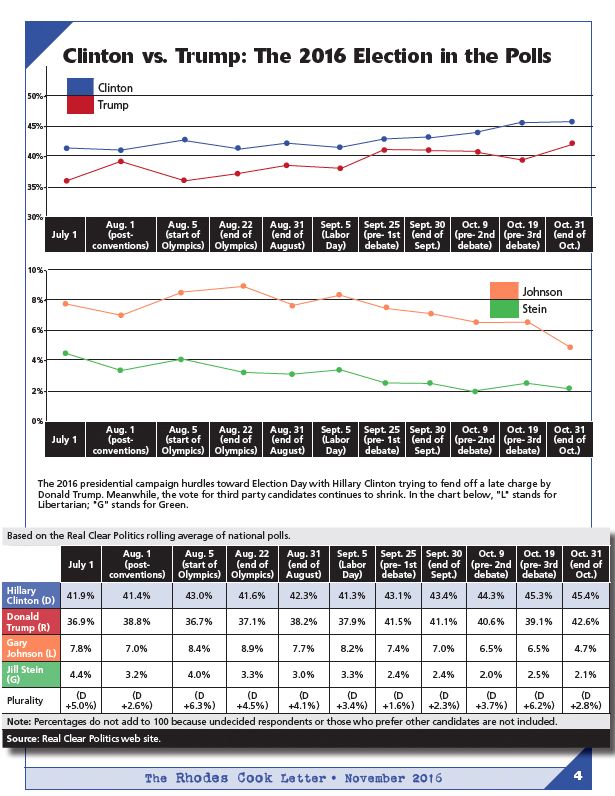 Line graphs are used to illustrate electoral trends, whether comparative poll data as above or electoral data.
January 2016 … “And Away We Go” (19 pages)
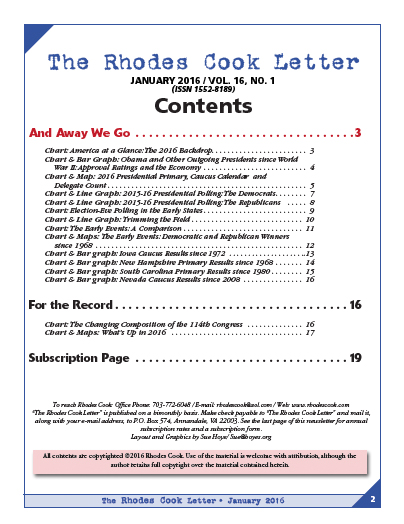
A preview of the 2016 presidential nominating contests, especially the four states that kicked off the voting in February (Iowa, New Hampshire, Nevada, and South Carolina).
February 2016 … “Apres SC, Le Deluge” (17 pages)

A look at the results of the opening events in February dominated by Hillary Clinton on the Democratic side and Donald Trump on the Republican. Also, a look ahead at the glut of March primaries.
March 2016 … “Meaningful Primaries Ahead” (18 pages)
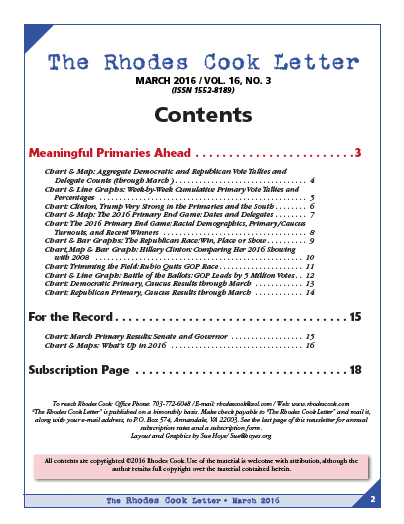
A detailed review of presidential primary and caucus results in both parties through March, and an opening look at 2016 congressional primary action.
July 2016 … “The ’16 Primaries: Making History” (25 pages)

Final thoughts (and numbers) on the 2016 presidential primary season, plus results from the spring congressional primaries.
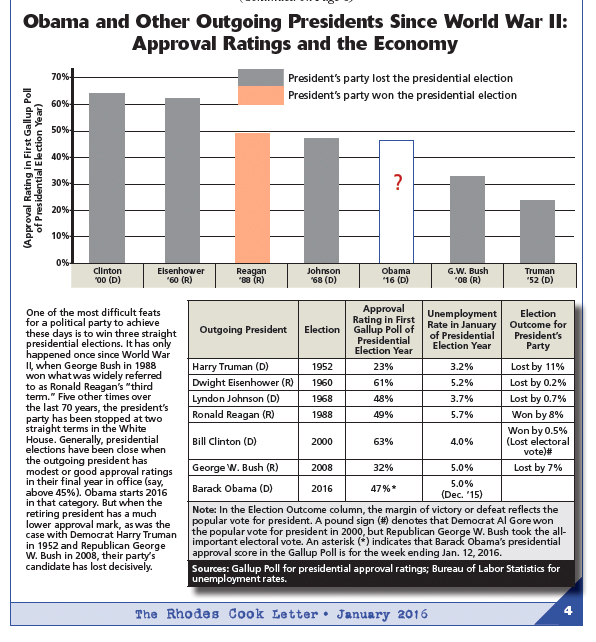 Bar graphs often compare various aspects of political data at a particular point in time, such as the standing of presidents at a similar date in their administrations.
September 2016 … “Is This Election Over?” (20 pages)

Emphatically “no” was the answer to the question posed in this issue. While Donald Trump looked unelectable to many political observers through the summer and fall of 2016, both major party candidates possessed clear strengths and weaknesses which made the race competitive to the end.
November 2016 … “A Divided America Votes” (18 pages)
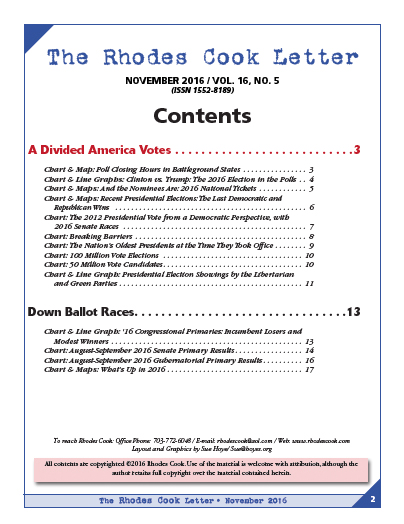
An election eve preview of the November 2016 balloting, with information on state polling hours, final polling numbers, and data putting the presidential election into historical context.
March 2017 … “An Election Like None Other” (19 pages)
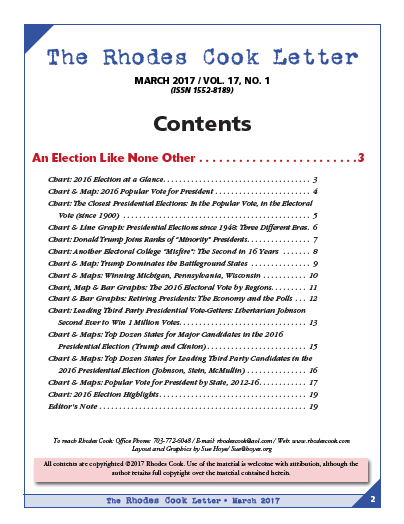
A first take on the stunning 2016 election results, with a focus on Donald Trump’s surprise victory in the presidential vote. The unexpected outcome was the product of a historical rarity: An Electoral College “misfire,” with different popular and electoral vote winners. It was only the fifth time in the nation’s history there was a “misfire,” but 2016 marked the second time it has happened since 2000.